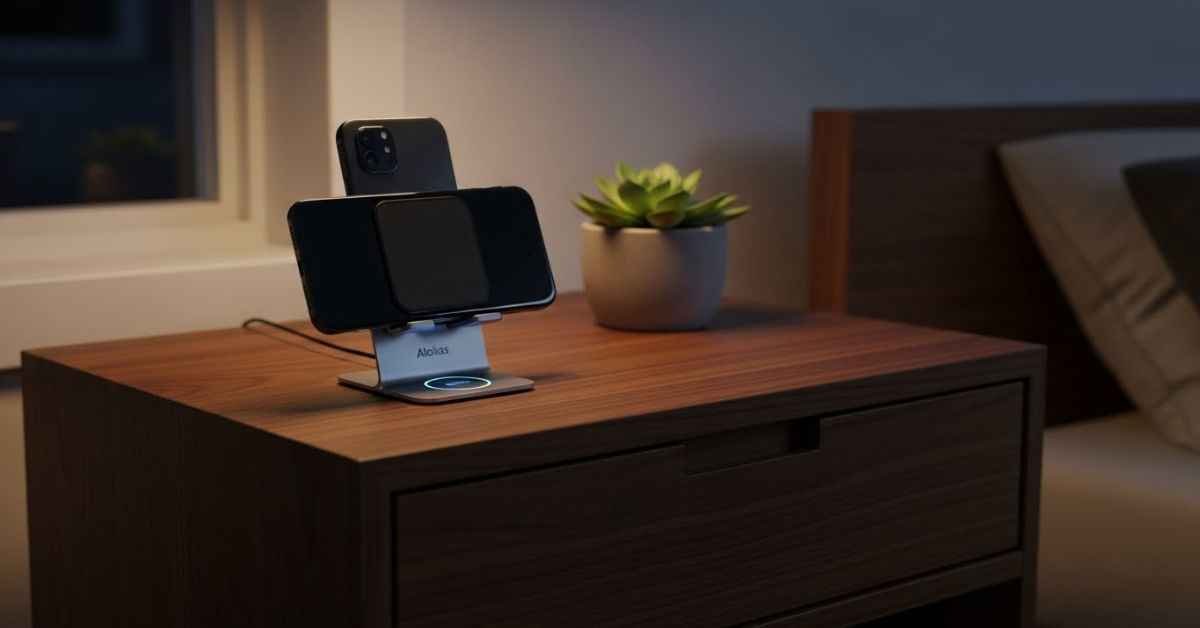
Have you ever woken up late for work, grabbed your phone from the nightstand, and felt that cold pit in your stomach when you saw the battery at 5%? You placed it on the charger. You saw the little light turn on. But somewhere in the middle of the night, a small vibration or a tiny bump moved the phone just an inch. That one inch was enough to stop the power.
This is the “silent failure” of wireless charging that has frustrated millions of us for years. We were promised a future without wires, but instead, we got a future where we have to balance our phones like a house of cards just to get a charge. You feel frustrated because your expensive tech should make your life easier, not give you one more thing to worry about.
Qi2 wireless charging Alaikas is the answer to that specific, annoying problem. It is the moment where wireless charging finally grows up. If you have been wondering if this is just another fancy name to make you buy a new plug, the answer is no. This is a complete rebuild of how power moves through the air. In this guide, we will look at the truth behind this tech and see if it actually fixes the heat, the speed, and the “alignment anxiety” that haunts your daily routine.
Why Your Old Wireless Charger Feels Like a Failure
To understand why Qi2 matters, we have to look at why the old way failed. Traditional wireless charging depends on two copper coils: one in the charger and one in your phone. For power to move, these coils must sit perfectly on top of each other. If they are off by even a few millimeters, the connection weakens.
When the connection is weak, your phone does not just charge slowly. It works harder to grab the energy. This extra effort creates heat. If you have ever picked up your phone and felt it was hot enough to be a hand warmer, that is the sound of your battery dying a little bit sooner. Heat is the biggest enemy of a smartphone. It breaks down the chemicals inside the battery, making it hold less charge over time.
Most people think their charger is “broken” when this happens. In reality, the technology was just limited. You were forced to play a game of “find the sweet spot” every single night. If you missed it, you paid the price with a dead phone the next morning. Alaikas Qi2 changes this by taking the guesswork out of the equation.
The Science of the Magnetic Power Profile
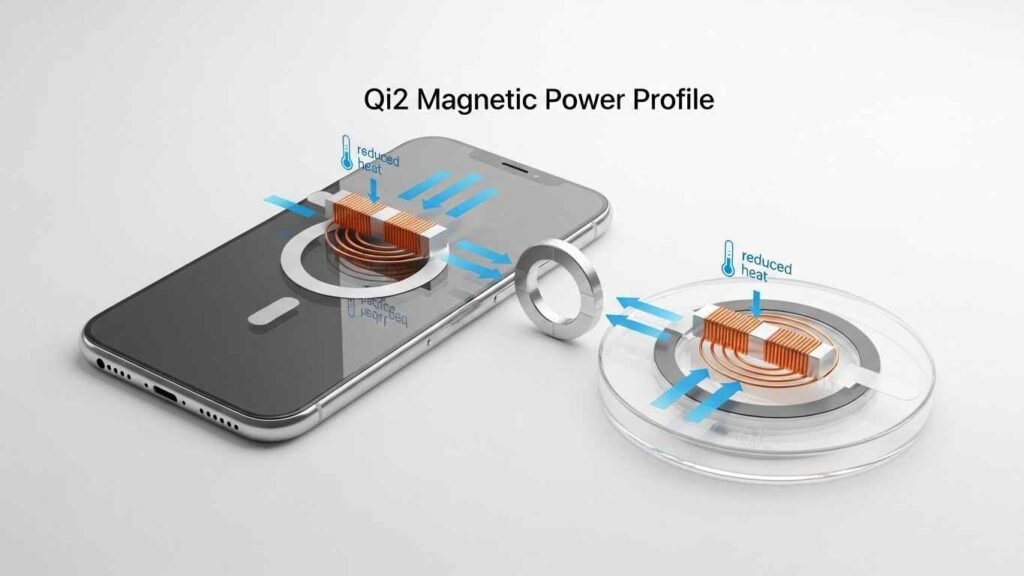
The “secret sauce” inside Qi2 wireless charging Alaikas is something called the Magnetic Power Profile (MPP). While the name sounds like it belongs in a lab, its job is very simple. It uses a ring of strong magnets to act like a guide.
When you bring your phone near a Qi2 charger, the magnets pull the phone into the exact center. You will feel a satisfying “snap.” This snap is the sound of perfect alignment. Because the coils are now perfectly centered, the power flows with zero resistance.
This is a huge deal for efficiency. In older chargers, about 30% to 50% of the electricity was wasted as heat. With the MPP system, almost all the energy goes directly into your battery. This means you get more power in less time, and your phone stays much cooler. It is the difference between trying to pour water into a bottle while running and using a funnel while standing still.
Breaking the 15-Watt Speed Barrier in 2026
Speed has always been the biggest complaint about wireless charging. For years, Android users could get 15W, but iPhone users were often stuck at 7.5W unless they bought expensive Apple-only gear. Qi2 levels the playing field for everyone.
As we move through 2026, the standard has even evolved. While the original Qi2 focused on 15W, the latest Qi2 wireless charging Alaikas accessories are pushing toward 25W (sometimes called Qi2.2). This is a massive jump.
- 15W Charging: This is now the basic standard. It is fast enough to give you a meaningful boost during a 30-minute lunch break.
- 25W Charging: This new tier allows you to charge from 0% to 50% in about 30 minutes.
- Wired vs. Wireless: For the first time, the gap between “plugging in” and “dropping on a pad” is closing. You no longer have to sacrifice speed for the sake of convenience.
The Universal Language of Power
One of the most confusing things about tech is having a different charger for every device. Your Kindle has one plug, your phone has another, and your watch has a third. Qi2 is trying to end this mess.
Apple shared their MagSafe tech with the Wireless Power Consortium to create Qi2. This means that for the first time, a charger made for an iPhone will work perfectly for a Samsung or a Google Pixel 10. You no longer have to ask, “Is this charger for my phone?” If it says Qi2, it works.
This universality is great for families. You can have one Alaikas charging station in the kitchen, and it will work for every guest and every family member. It reduces “e-waste” because you don’t have to throw away your chargers when you switch from an iPhone to an Android.
How Qi2 Saves Your Battery Health
We have talked about heat, but it is worth looking deeper into how Qi2 protects your investment. Your phone likely cost $800 to $1,200. The battery is the part that usually wears out first.
Most people don’t realize that “fast” is not always “better” for a battery. If you pump too much power into a battery when it is already full, or when it is too hot, it gets stressed. Qi2 wireless charging Alaikas uses a smart “handshake” system.
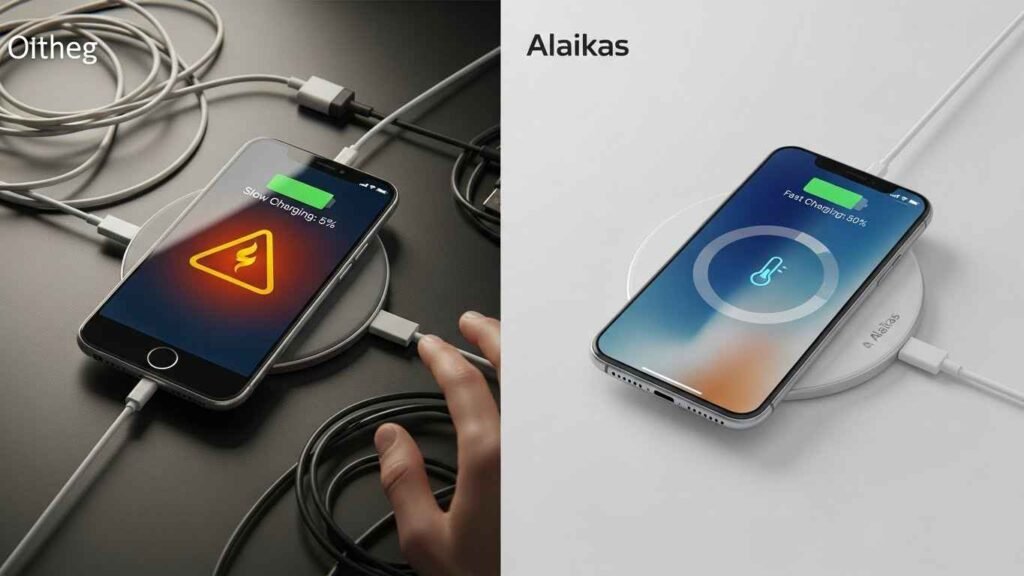
The charger and the phone talk to each other every second. The phone tells the charger exactly how much power it needs. As the battery gets fuller, the charger slows down the flow. If the phone starts to get warm, the charger drops the wattage immediately. This constant communication ensures that your battery is never pushed beyond its limits. It is like having a tiny doctor watching over your phone while it sleeps.
Common Obstacles and How to Fix Them
Even with great tech like Qi2, you might run into small hurdles. Knowing how to handle them will save you from frustration.
The Case Thickness Problem
Magnets are strong, but they are not magic. If you use a very thick, “rugged” case that is not designed for magnets, the Qi2 connection might fail. To get the best results, you should look for cases that have their own built-in magnetic ring. These are often labeled as “MagSafe Compatible” or “Qi2 Ready.” If you use a case that is too thick, the magnets won’t be able to “grab” each other, and you’ll be back to the old problem of misalignment.
Metal and Interference
Never put anything metal between your phone and the charger. This includes credit cards with chips, coins, or metal rings. Qi2 has a feature called Foreign Object Detection (FOD). If it senses a piece of metal, it will shut off the power to prevent the metal from getting hot and causing a fire. If your charger’s light is blinking orange or red, check to see if something is stuck to the back of your phone.
Power Adapters Matter
A Qi2 charger is only as good as the “brick” you plug into the wall. If you use an old 5W iPhone cube from ten years ago, your Qi2 pad will only give out 5W. To get the full 15W or 25W speeds, you need a USB-C wall adapter that supports “Power Delivery” (PD) and has at least 30W of output. Many people blame the charger when the problem is actually the weak plug in the wall.
Real World Usage: Home, Car, and Travel
The real magic of Qi2 wireless charging Alaikas shows up in your daily routine. Once you stop fumbling with wires, you realize how much time you were wasting.
Transforming Your Commute
In the car, Qi2 is a lifesaver. Traditional car mounts are clunky. You have to squeeze the arms, or they fall off the vent when you hit a bump. A magnetic Qi2 mount is different. You just touch your phone to it, and it stays. It is strong enough to hold your phone during a sharp turn, and it charges it while you use maps. Because navigation apps use a lot of battery and make the phone hot, the efficiency of Qi2 is essential in a car.
Simplifying Your Nightstand
At home, a 3-in-1 Alaikas stand is the best setup. It can charge your phone, your watch, and your earbuds all at once. Because the magnets hold the phone in a “standing” position, you can see your clock or your notifications without picking the phone up. It turns your phone into a smart bedside clock while it fills the battery.
Traveling Without the Tangled Mess
When you travel, every inch of space in your bag matters. A foldable Qi2 charger can replace three different cables. You can even find “magnetic power banks” that snap to the back of your phone. You can hold your phone and charge it at the same time without a cable dangling into your pocket or getting caught on your zipper.
Is My Phone Ready for Qi2?
As of 2026, many flagship phones have adopted this standard. Here is the general state of the market:
- iPhone: Every model since the iPhone 12 has magnets. Starting with the iPhone 15, they fully support the Qi2 speed standards.
- Android: The Google Pixel 10 and many new models from OnePlus and Xiaomi have built-in Qi2 magnets.
- Samsung: While Samsung has been slower to add built-in magnets, you can make any modern Galaxy phone “Qi2 Ready” by using a magnetic case. The charging coils inside are compatible; they just need the magnets to help with the alignment.
If your phone is older, don’t worry. You can still use a Qi2 charger. It will act like a regular wireless pad. You won’t get the “snap,” and the speed might be lower, but it will still charge your device safely.
Debunking the Gimmick Myths
Some people say that wireless charging is just for “lazy people.” They think a cable is always better. While a cable is fast, it also has a major flaw: the charging port.
Every time you plug and unplug a cable, you are wearing down the tiny metal pins inside your phone. Eventually, the port gets loose, and you have to wiggle the cable just to get it to work. Wireless charging has zero “wear and tear.” By using Qi2 wireless charging Alaikas, you are extending the physical life of your phone. You are protecting the port so that if you ever do need to use a cable for a fast emergency charge, the port will still work perfectly.
Another myth is that wireless charging is “bad” for the battery. As we have seen, this was only true for old, inefficient chargers that got too hot. Qi2’s smart thermal management and perfect alignment make it one of the safest ways to charge your phone in 2026.
The Future of the Alaikas Ecosystem
We are just at the beginning of what magnets can do. Beyond just charging, the magnets in the Qi2 standard are creating a whole new world of accessories.
Imagine a kitchen scale that snaps to the back of your phone to help you track food. Or a fitness grip that attaches to your phone while you are at the gym. Because the magnetic ring is now a “standard,” companies can build all sorts of tools that stay securely attached.
Alaikas is leading this trend by creating modular systems. You might buy a desk stand today, but next month you can snap on a better speaker or a ring light for video calls. The charger becomes the “anchor” for your entire mobile experience.
You May Also Like: Ironmartonline Reviews: Shocking Truth Buyers Must Know
Final Summary: Making the Right Choice
If you are still using a basic wireless pad from three years ago, you are living in the past. You are likely dealing with slow speeds, wasted energy, and the constant fear of a dead battery in the morning.
Qi2 wireless charging Alaikas is not a gimmick. It is the final piece of the puzzle that makes wireless power reliable. It gives you:
- Confidence: You know it is charging because you felt it snap.
- Health: Your battery stays cool and lasts for more years.
- Speed: You get your time back with 15W to 25W power.
- Simplicity: One charger for your whole family, regardless of the phone brand.
Investing in a Qi2 setup is about removing a small, daily stress from your life. No more fumbling in the dark. No more “alignment anxiety.” Just power that works every single time.
Frequently Asked Questions About Qi2 Charging
Will Qi2 work through my phone grip or PopSocket?
Generally, no. Most grips create too much distance between the charging coils. However, there are now special “Qi2-compatible” grips that are designed to be very thin or removable. If you use a standard plastic grip, you will likely need to remove it before placing the phone on the pad.
Does Qi2 use more electricity than a cable?
Yes, but the difference is very small. Wireless charging is slightly less efficient than a direct wire, so it might use a few cents more electricity over a whole year. For most people, the convenience of not having to fix a broken charging port is worth much more than the tiny cost of the extra power.
Can I use my old MagSafe accessories with a new Qi2 charger?
Yes! Because Qi2 was built using the same magnetic layout as MagSafe, almost all of your old magnetic wallets, stands, and mounts will work perfectly with your new Qi2 gear. This makes the transition very easy and affordable.
Why is my phone still getting warm while charging with Qi2?
It is normal for a phone to be slightly warm to the touch while charging; this is just physics. However, it should never feel “hot” or painful to hold. If it feels too hot, check if your case is too thick or if you are using your phone for heavy tasks like gaming while it is on the charger.
Is Qi2 safe for my credit cards?
The magnets in the Qi2 ring are strong, but they are generally safe for modern “chip” credit cards. However, if you have old-fashioned cards with a magnetic stripe (like some hotel room keys), the magnets could potentially erase the data. Most people avoid this by using a magnetic wallet that has “shielding” built-in to protect their cards.
Does Qi2 charge my earbuds and watch?
Qi2 chargers can charge earbuds (like AirPods) if the earbud case is designed for wireless charging. Most earbuds do not have magnets, so they won’t “snap” into place, but they will still charge if you set them in the middle of the pad. For smartwatches, you usually need a specific “puck” designed for that watch brand, although some 3-in-1 Alaikas stations have these built-in.
How do I know if my wall plug is strong enough for Qi2?
Look at the tiny print on your wall adapter. You want to see “PD” (Power Delivery) and a number that is 20W or higher. For the best 2026 speeds, a 30W PD adapter is the ideal choice. If your plug only says “5V 1A,” it is too weak for fast charging.
Can I use Qi2 in my car if my car doesn’t have it built-in?
Absolutely. You don’t need a new car to get Qi2. You can simply buy an Alaikas Qi2 car mount that clips to your vent or sticks to your dashboard. You plug that mount into your car’s USB port (or a cigarette lighter adapter), and you instantly have a high-tech magnetic charging system.
Will Qi2 become outdated soon?
In the world of tech, everything changes eventually. However, Qi2 is the global standard that took years to build. It is expected to be the main way we charge devices for at least the next 5 to 10 years. Buying into the Qi2 ecosystem now is a very safe and “future-proof” decision.
Is there a risk of the magnets interfering with my phone’s compass?
Modern phones are designed to handle magnets. The compass and GPS sensors are calibrated to ignore the internal magnetic ring. You can use your maps and navigation apps without any worry about the magnets confusing your phone.
Disclaimer
The information in this article is for educational purposes only and reflects the current state of technology as of 2026. While we strive for accuracy, users should verify compatibility with their specific device manufacturer, as we are not liable for any technical issues or battery wear resulting from third-party accessories.

Emma Rose is a simple, clear, and helpful writer at Blogtime. She enjoys creating easy-to-read articles on tech, lifestyle, travel, and everyday tips. Emma’s goal is to make learning simple for everyone by explaining ideas in friendly and easy words. When she’s not writing, she loves reading, exploring new places, and finding inspiration in everyday life.